The Flexibility of Platform Fighters
This essay mentions a lot of games that I have little playtime with or haven't played at all. A lot of these games are sadly defunct, so I can't play them for research. I've done my best to paint at least a somewhat accurate first impression of them based on various gameplay reviews and videos others have authored while these games were still active. Also, this is the first essay I've written outside of an academic context. I don't think it's terribly good, but I'm glad I got something out there eventually!
Introduction
The platform fighter is easily my favorite video game genre and one that has had a profound impact on how I view and experience video games. Much of the appeal of the genre is sourced from the satisfying movement and freedom of platformers combined with the intricate mindgames and strategy of fighting games. I could go on and on ad infinitum about what aspects of the genre make it so appealing to me and others, but despite its broad appeal and proven fun the genre has only achieved relatively modest success outside the series that birthed it: Super Smash Bros.
The topic of how plat fighters can better expand their audience beyond that of Smash Bros. has been discussed many times before. A wide variety of theories and explanations have surfaced, ranging from “we just need to give it time” to “every other attempt of the genre simply sucks compared to Smash”. These posits tend to have at least some validity to them, but they will not be iterated upon here. Instead, I will forward a positive yet seldom discussed aspect of plat fighters that has been mostly left out of the equation, but is slowly starting to be realized. An advantage that not even its arguably more influential cousin (traditional fighting games) grappling with the same dilemma has.
Platform fighters have the advantage of flexibility
What I mean by flexibility is that plat fighters can be easily shaped and molded to fit a wide variety of gameplay loops. There are two main reasons for this. First, plat fighters are a direct derivative of the 2D side-scrolling platformer, which itself is one of the most foundational and thus flexible game genres of all time. You can find platformer DNA in most popular genres nowadays; jumping, multi-dimensional movement, and acceleration mechanics can be found in first-person shooters, side-scroller action games, and so on. The second reason is game genres can be defined in whole or in part by their control scheme, objective, and theme (theme is entirely irrelevant, so the focus is placed on the control scheme and objective).
Plat fighters are defined wholly by their complementary control scheme and objective. In plat fighters, the primary objective is to knock your opponent(s) off the stage and into the blast zone by either launching them into it or depriving them of their ability to recover back to the stage. Damage is accumulated via a percentage system, where attacks deal a set amount of percent (ignoring move staling) with base knockback that scales with the victim's percent. The 2D-platformer-inspired control scheme of plat fighters complements this objective well; players are flying in all sorts of directions across the 2D plane from the knockback, so a movement system that allows for free traversal both on the ground and in the air is necessary. Additionally, the scaling knockback lends to a dynamic advantage state, where the player has to adjust their movement and timing of attacks based on the percent of their opponent and even what direction they're holding during a combo (directional influence). As mentioned in the very beginning, the appeal of plat fighters comes from the emergence of an intriguing combat system derived from the free platform movement combined with a scaling knockback system resulting in interactive combat regardless of whether you're the one hitting or the one getting hit.
The crux is that the excellent control scheme of plat fighters allows us to more freely manipulate its objective to create new, engaging forms of gameplay. However, we still have to be careful. We've established just earlier that the control scheme and objective are coupled; mindlessly changing one can negatively impact the other. With that being said, the remainder of this essay will now go through both real and theoretical examples of compelling variations of the plat fighter.
Rushdown Revolt
Rushdown Revolt has had a storied history as a plat fighter. It's derived from the decrepit remains of the uninspired Icons: Combat Arena, which was essentially a 1:1 Melee clone with an unbelievably forgettable art style. Unsurprisingly, the game failed to establish a core audience and quickly died alongside its developer, Wavedash Games. Developers from Wavedash then repurposed the game's assets to make a new game with all-new anime-fighter-inspired gameplay.
Completely opposite of its predecessor, Rushdown Revolt did a great job modifying the base plat fighter into something interesting while still remaining recognizable. The first change was introducing elements from over-the-top anime-fighters to the control scheme; the two primary examples are a dedicated “dash” button allowing players to perform an instant wavedash on the ground or a directional air dash if airborne and a resource called "Spark" that allows players to cancel attacks into a dash. Spark is obtained simply whenever the player hits an opponent without already having it. Outside of the dash button and Spark system, Rushdown Revolt's control scheme remains largely identical to Smash Bros.
A more unique change Rushdown Revolt does is to how damage is scaled and applied to knockback (part of the objective of plat fighters). The linear percent-based knockback scaling is replaced with an HP bar (à la Stamina mode in Smash Bros.) partitioned into four discrete “knockback thresholds”. 150-100 HP is low knockback, 100-65 is medium knockback, 65-25 is high knockback, and 25-0 is very high knockback.
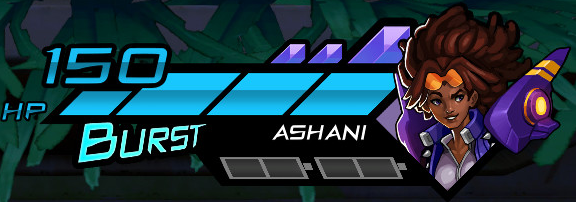
Getting down to 0 HP actually does not immediately result in a stock loss. Instead, you get placed into a “last hit” state. In this state, your opponent(s) need to land three solid hits on you with strong moves. This system resolves the low HP issue with stamina mode where it was trivial to finish off weak opponents with easy-to-hit, low-risk projectiles that promoted degenerate play.
Speaking from personal experience, I really enjoyed Rushdown Revolt, particularly with its addictive combo game developed from the air dash and Spark mechanics. It acutely demonstrates how principles from other genres can be applied to plat fighters to create new gameplay without really deviating that far from the base plat fighter formula. However, the following examples take greater strides in modifying the plat fighter genre, particularly through additions to the objective that are inspired by other, successful genres.
Roguelites
Roguelites are truly a game design cheat code. Much like what I'm trying to argue with plat fighters, you really can slap a roguelike onto essentially any game genre and come up with something fun. They're another example of a flexible game genre, and so it shouldn't come to much of a surprise that Roguelites are seeing increasing application to plat fighters and the wider game industry.
Defining what a Roguelite is vs a Roguelike is, unsurprisingly, a hotly-debated and confusing endeavor. I will be (vaguely) defining a “Roguelite” as a game that features heavy randomization and permadeath with or without meta-progression. Roguelites also feature powerscaling for the player as the run progresses in response to the increasing strength of the enemies. Player power is usually distributed as random items or modifiers that the player can collect or earn. Roguelikes to me are something else.
The first example that comes to mind is the so-called "Roguelike Mod” (more a Roguelite under our definition) for Super Smash Bros. Melee. The concept is pretty simple: after every stock loss, a player selects one of four random items or buffs on their respawn. The nature of these buffs ranges widely: increased damage, reverse knockback, extra jumps, and so on. There are some more esoteric items as well, such as an item that allows the player to place a bumper at any position on the stage before their respawn.
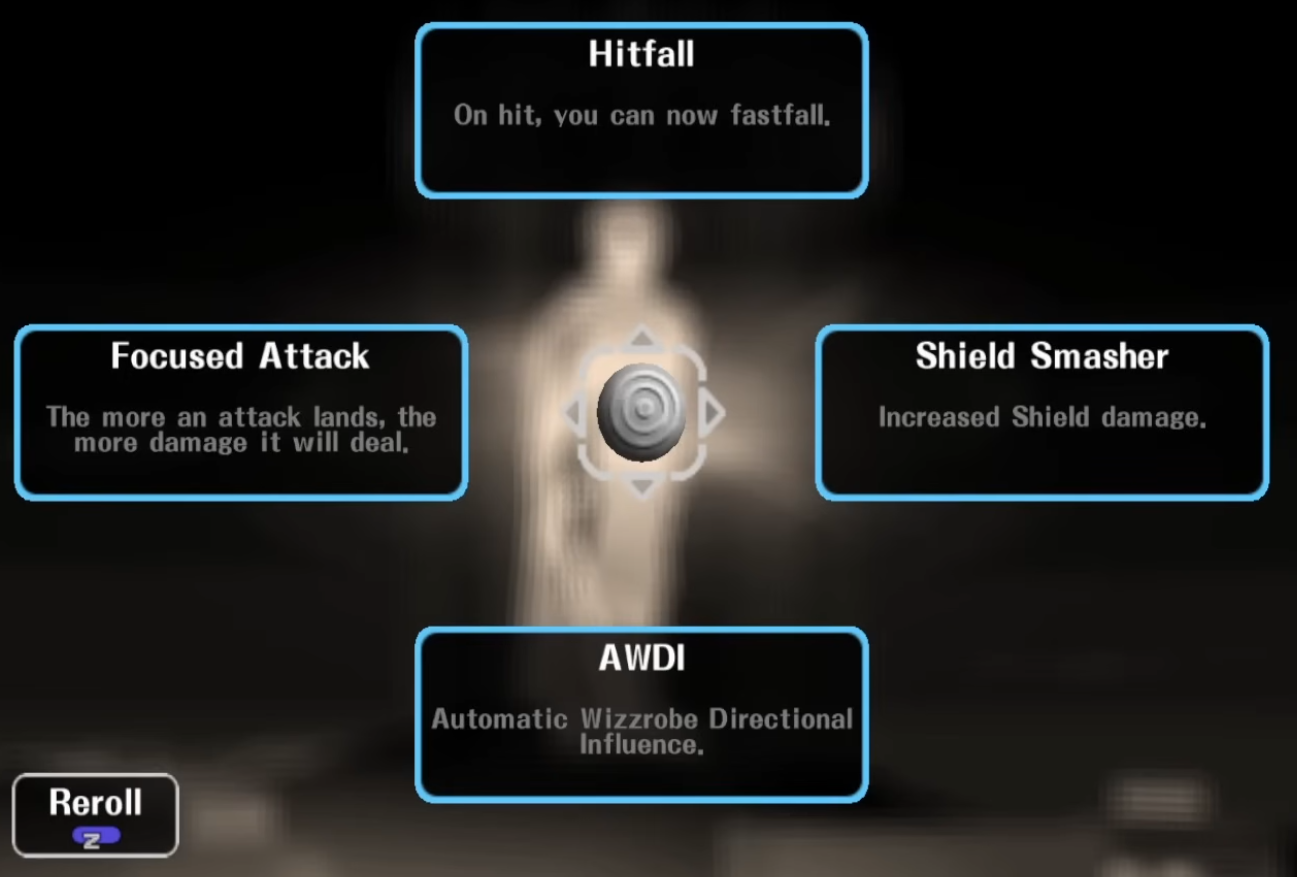
It's difficult to call the “Roguelike Mod” an actual Roguelite, as the randomization is relatively limited due to the small pool of modifiers while also not being integral to the gameplay loop of Melee. Regardless, it serves as a small yet practical glimpse into how the randomization roguelites can enhance the already excellent replayability of plat fighters.
Classic Mode and Multi-Man Smash in Smash Bros. and Rival of Aether's Abyss Mode more closely fit the condensed run-based gameplay loop with increasing difficulty you would expect from a roguelite. However, these modes have limited to no randomization and therefore cannot be earnestly classified as roguelite modes. The stages in Classic Mode are predefined for each character, there is only one type of enemy in Multi-Man Smash, and Abyss Mode only has meta-progression with little variety in enemies and no variation in enemy waves between runs. These modes, however, serve as the foundation upon which randomization, variety, and progression can be introduced to create a roguelite mode.
I also want to give a shoutout to Combo Devils and Spiritfall. Combo Devils is an upcoming platform fighter that incorporates many mechanics from traditional fighters and will also feature an “extraction roguelite” mode. Spiritfall, to my surprise, is a fully complete game released two years ago that advertises itself as a roguelite with plat-fighter-inspired content. I have played neither Combo Devils nor Spiritfall yet, so unfortunately I can't really comment much on them, which is admittedly a shame because they're probably the two most prominent and practical examples of roguelites working within a plat fighter frame.
If Combo Devils appeals to you, I highly recommend giving them your support through their kickstarter. Also checkout Spiritfall
Battle Royale
Feels a little bit silly for me to talk about Battle Royales in the big 2026, but I feel it's worth mentioning them because their scale offers an interesting design challenge for a genre with a confined 2D side-scroller view (we'll talk about perspectives in a later section).
We've seen a tidbit of what a larger scale plat fighter with a lot of players would look like in the form of 8-Player Smash in Smash WiiU/3DS/Ultimate. The mode is fun initially from its novelty, but I've found that the concessions the developers have made in order for it to work have hampered the long-term enjoyability of the mode. The first obvious problem is stage design. Smash stages have historically been made to support four players, and with double the player count, most stages end up playing out as incomprehensible, unpredictable chaos that is un-fun in the long term. There are a handful of stages that can work with more than four players, the most prominent example being Hyrule Temple. Regardless, much of the game's content (stages) becomes undesirable with more than four players. The obvious solution is to make bigger stages, which is what the Smash team ended up doing with Big Battlefield, The Great Cave Offensive, and Palutena's Temple.
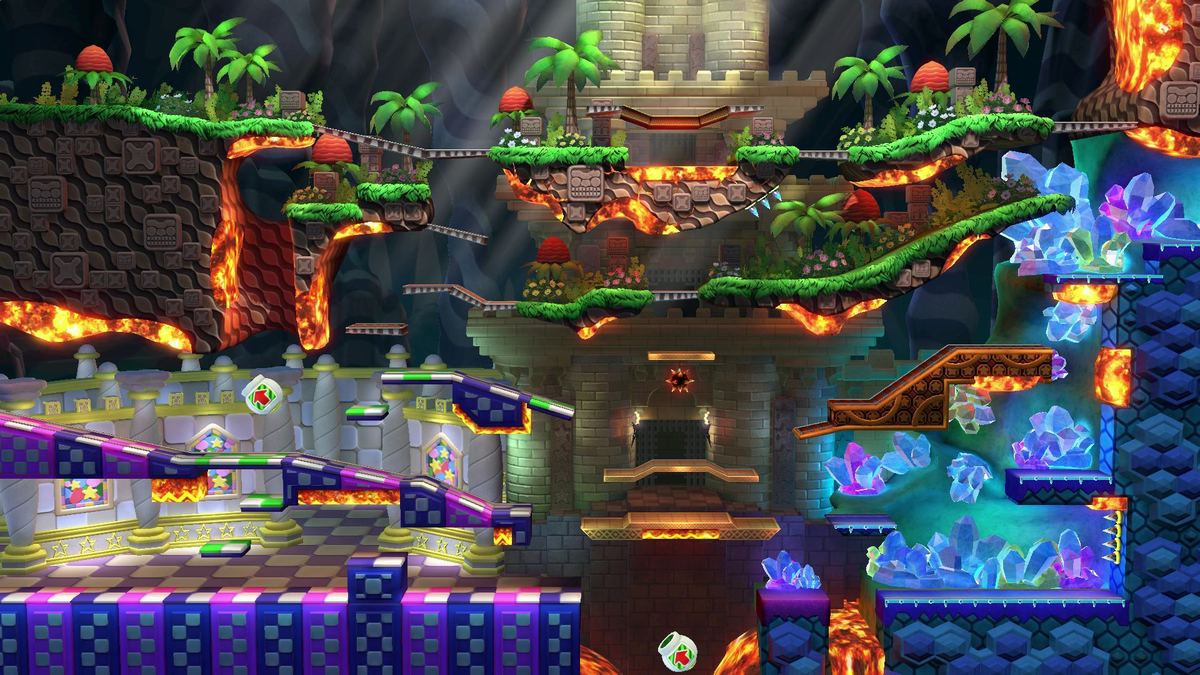
One of the most prevalent issues with large stages is camping and running away. In stock battles, running away is always optimal because it allows you to avoid taking damage and thus allows you to play for longer since your stocks will go down slower. In timed or score battles, it is optimal to run away once you have developed a score lead so as to not lose it. In all cases, running away works well because stages provide enough space to run away to. Battle royales like PUBG Battlegrounds and Fortnite also share this same problem from their large maps, but they offer two countermeasures: a shrinking map border and valuable loot dispersed randomly at high-risk landmark locations. Large stages in Smash are also vulnerable to the Hyrule Temple Problem, which refers to the intense difficulty of eliminating the stocks of high percent opponents within enclosed space due to them bouncing between the walls and ceiling when hit, preventing them from reaching the blast zones.
Smash Bros. 3DS has a mode called Smash Run that shares many similarities with a battle royale but solves the defensive problems of a large map in a completely different way. In Smash Run, each player explores an isolated instance of a large map with various objectives and enemies, from which players can pick up power ups that enhance an individual stat of the character they control (i.e. speed, power, defense, etc.). After a couple of minutes have passed, players are immediately transported to a challenge game where they will have to compete with other players directly using their powered up character. There are no other players to run away from during the initial phase of Smash Run, so there is no incentive for defensive or passive play for the majority of Smash Run. Additionally, players are teleported to a smaller stage for the second phase, carrying the same functionality as the shrinking map border from standard battle royales and also sidestepping the Hyrule Temple Problem.
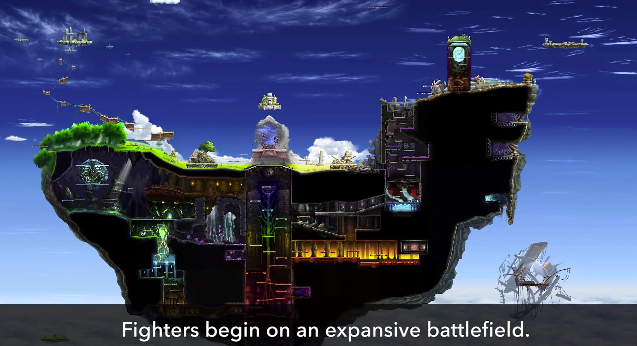
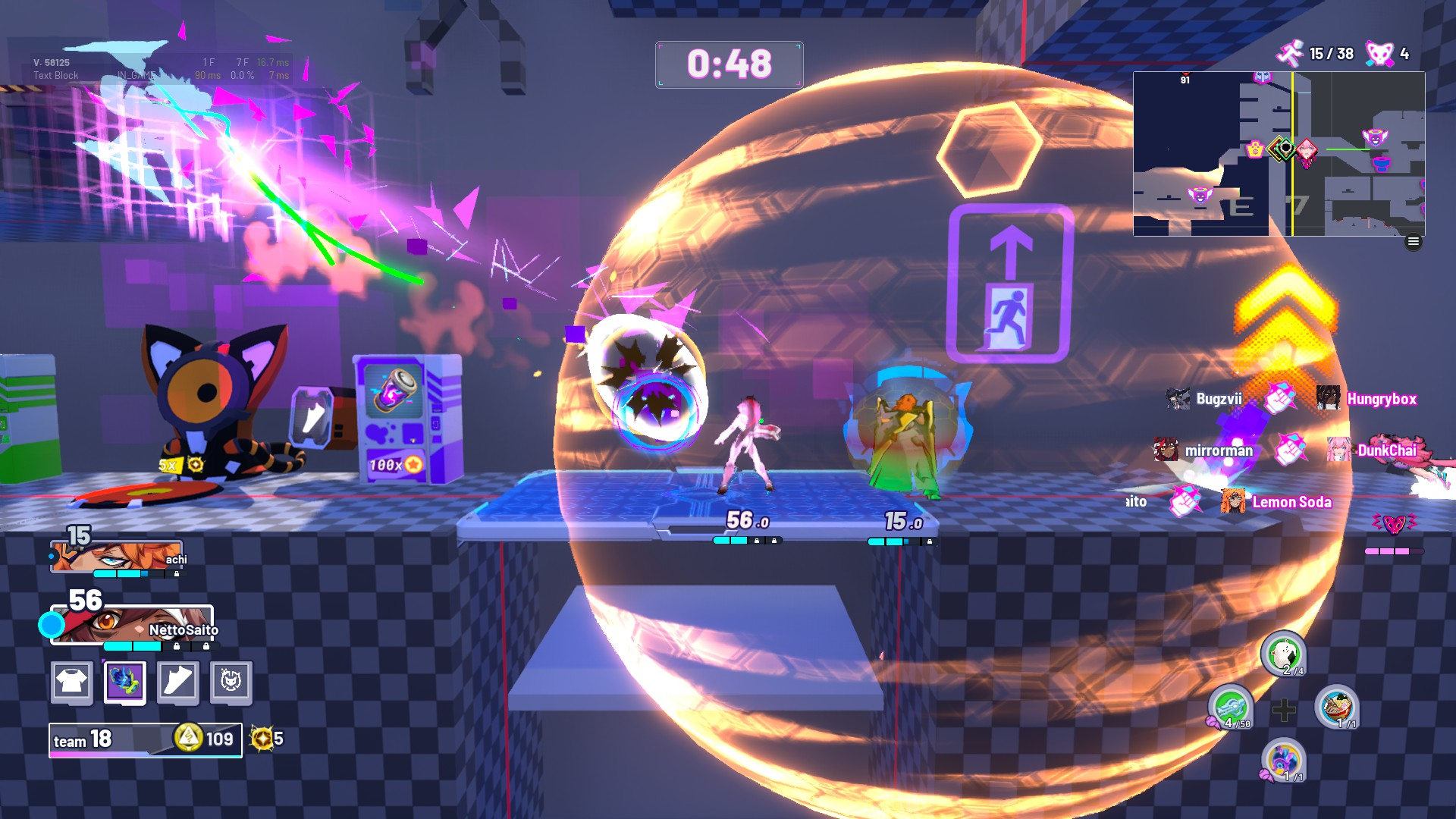
While it's difficult to classify Smash Run as a battle royale in the traditional sense due to its low player count and single-player instanced map where most of the game takes place, there have been recent attempts to make true plat fighter battle royales. Byte Breakers was a canceled plat fighter that adopted the battle royale formula to the fullest with up to 40 players on a single large map with an enclosing border to force interactions. In Byte Breakers, players can power up through the collection of passive “Gears” and active items that spawn throughout the map. The Hyrule Problem is avoided through a hybrid knockback-stamina HP system and death traps that you can knock other players into (similar to the lava patches in Smash's Great Cave Offensive stage). Players start at 100 HP with knockback increasing as their HP depletes to zero, where they will then die. Combo Devils also employs a similar system, with players dying after reaching 200% knockback starting from 0%. Rushdown Revolt's HP and last hit system would also work great here, and you can have the knockback partitions also serve as thresholds for various traps.
MOBA
MOBAs are an objective-based genre focused on increasing the strength of your character over the course of a match through destroying various objectives in order to become powerful enough to destroy the enemy base alongside your teammates. MOBAs originated from real-time strategy games like Warcraft and StarCraft and have historically adopted their over-the-top mouse-based control scheme. However, being an objective-based genre allows MOBAs to employ control schemes vastly different from that of RTS games, demonstrated by the abundance of MOBAs released over the years that have successfully implemented alternative control schemes.
Smite is notable as it was a broadly popular MOBA that featured a third-person behind-the-back perspective. Smite's third-person perspective offered a key advantage over the traditional RTS control scheme in that it allowed the use of console game controllers, leading the game to be playable on Xbox and PlayStation consoles. This massively widened the audience for the game, which would have otherwise been restricted to a smaller (but still large) market of PC gamers. However, Smite's gameplay was still heavily reminiscent of other RTS-based MOBAs in the sense that the movement was restricted to slow grounded movement with vertical movement being restricted to character-specific abilities.
The yet-to-be-released Deadlock is a better example of a popular MOBA with more distinct gameplay compared to traditional RTS-based MOBAs. Like Smite, Deadlock takes on a third-person perspective. However, Deadlock distinguishes itself by emphasizing shooter and movement mechanics found in FPS games, allowing players to much more freely traverse the map both horizontally and vertically. Deadlock's map features lanes and a jungle like any other MOBA, but accommodates the increased movement capability of its characters with varying elevation in the form of the concrete forest of New York City.
The last game I want to mention is Awesomenauts, which is a 2D side-scrolling platformer MOBA that so far is the closest example of what a plat fighter MOBA would look like. Since plat fighters are a direct descendant of 2D platformers, many of the design elements in Awesomenauts can be applied to a theoretical MOBA plat fighter. In particular, we can look at Awesomenauts' map design to see how typical elements of MOBA maps can be adapted to a 2D platformer control scheme.
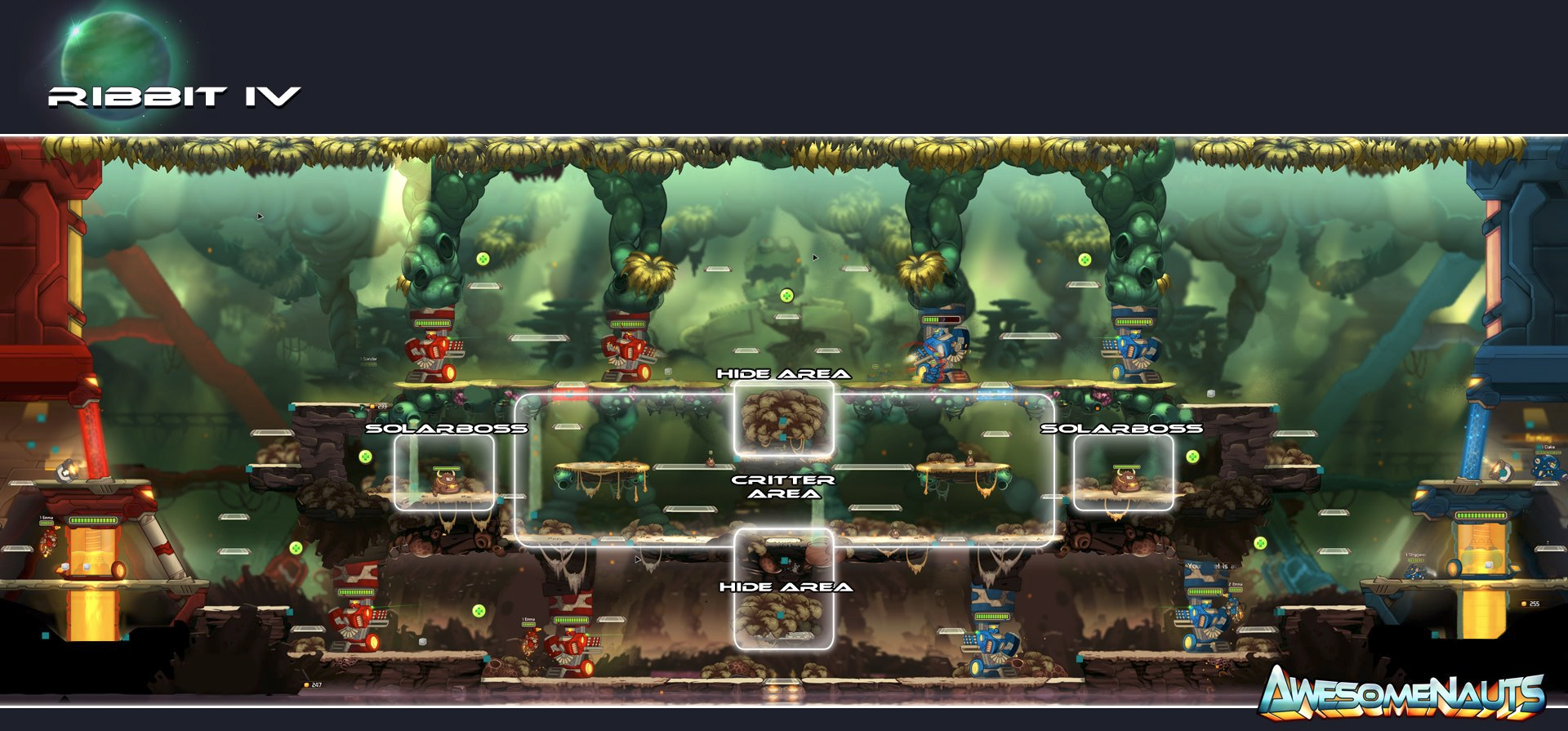
Awesomenauts is a bit unique in that it features multiple maps instead of just one, but they all feature two lanes with “critter areas” (aka the jungle) placed either in between the lanes, above the lanes, or below the lanes. Traversal between the lanes or jungle is accomplished through ascending platforms that players can jump through from below and land on. The map is smaller and less elaborate compared to traditional MOBA maps, which aligns with Awesomenauts' intent to offer a simplified MOBA experience with its reduction in player count (3v3 instead of 5v5) and average match length. While Awesomenauts' maps are still far larger than standard plat fighter maps, they do resemble Smash's 8-player stages and Smash Run's first phase stage at a cursory glance; it's easy to imagine how jungle creeps can be placed on a maze-like stage such as The Great Cave Offensive.
Awesomenauts' control scheme in regards to attacking or ability use is nearly identical to that of traditional MOBAs. All playable characters have a simple, low cooldown standard attack initiated with the left mouse button known as an “M1”. Additionally, each character has four abilities, with each active ability assigned to a keyboard key or controller button. Unlike the M1 attack, offensive active abilities carry more damage and more stun (or “crowd control”) at the cost of a long cooldown. In plat fighters, each standard attack applies stun and displaces the enemy with knockback. Special attacks (akin to abilities in MOBAs) also do not have explicit time-based cooldowns. Every basic attack leading to a stun/combo works fine in isolated fights. Most fighting games, including plat fighters, focus on 1v1s, and 2v2 formats in plat fighters introduce a manageable amount of chaos that can add even greater strategy. However, MOBAs often feature large team fights with up to 10 players concentrated at key objectives. Stuns, especially in team fight settings, are already a point of contention for many newcomers to the MOBA genre despite being manageable (and even a key part of strategy) with long cooldowns. This begs the question: would large team fights be fun if every attack stunned and displaced you? Probably not, although there is no way of truly knowing without playtesting. The simplest and most obvious solution would be to have a lower player count, much like Awesomenauts. As previously mentioned, the lower player count would also constitute a smaller map size with a shorter game length and lower number of objectives. Therefore, a plat-fighter-based MOBA would work best with a team size no larger than 3 with an average game length of 15-20 minutes. Compacting the MOBA gameplay would also serve to increase the appeal of this theoretical game to the wider fighting game audience, who are used to shorter games and may be less inclined to commit up to 45 minutes for a single game.
Perspective
Lastly, I want to quickly talk about perspective. All of the previous topics have been about modifying the objective based on a preexisting genre, but changing the perspective is related to the control scheme. Plat fighters are typically played from a 2D side-to-side perspective, but much like old-fashioned platformers, the genre isn't inherently limited to this perspective.
DKO is a third-person 3D plat fighter by the same folks who made Smite (Hi-Rez Studios). The primary objective of DKO remains unaltered from traditional plat fighters: rack up damage (percentage) on your opponents and knock them off the stage and into the blast zone for a knockout. However, given the perspective change, the control scheme differs significantly from 2D plat fighters and more closely resembles Smite. Each character has four abilities with time-based cooldowns assigned to a single button. Standard attacks are separated into light attacks and chargeable heavy attacks, with both having a grounded and aerial version. Attacks (both abilities and standard attacks) do not change based on the movement direction the player is holding; an understandable change given how an additional dimension would make a direction-based control scheme for attacking more unintuitive.
I *do* think a direction-based attack control scheme could still work. Horizontal attacks (i.e. forward or back air attacks) can be based on movement direction. For example, holding W in the air results in a forward air attack and holding S results in a back air attack. Vertical attacks can be based on vertical camera movement: looking up results in an up air and looking down results in a down air (since character models don't freely rotate on the vertical axis). As mentioned previously, this isn't exactly intuitive, so it's understandable why Hi-Rez opted to use a MOBA-inspired control scheme instead.
Many mechanics from 2D plat fighters have been stripped out, especially those with roots in traditional fighting games. There are no techs, knockdowns, advanced ledge options, shields/blocking, grabs, wave dashes, directional influence, and so on. Furthermore, the map design is wide and flat with little to no platforms. This results in gameplay that looks unrecognizable from 2D plat fighters if it weren't for the objective being the same, and this is why adjusting the control scheme of plat fighters risks diluting the identity of the genre moreso than changing the objective. To reiterate the start of this essay, much of the appeal of plat fighters comes from its excellent control scheme, and more care needs to be taken when translating the genre into a new perspective.
The last alteration I want to discuss is a first-person perspective, which also happens to be the least explored. To my knowledge, there are no notable examples of a first-person plat fighter, let alone a first-person fighting game. Melee combat in first-person games has historically been pretty simple: simply click to swing your sword to hit your opponent if they're in range. Games that feature historical medieval combat such as Chivalry offer more elaborate melee systems, but they don't tend to have many hallmarks of the fighting game or plat fighter genre (i.e. combos, special moves, etc.).
The only concrete example I can think of for a “first-person plat fighter” would be the Smash Bros. mod for Team Fortress 2 that implements a percentage-based knockback system in place of the simple HP system, but this example is highly dubious since the majority of combat in TF2, as a first-person shooter, is carried out through ranged weapons.
I'm gonna do a bit of self-promotion here and mention a game I'm making myself that you could consider a “first-person plat fighter” in a limited sense. The game in question is titled Grapple Fight, and it's a standalone implementation of the Grapple Knife gamemode in the long defunct sandbox game Blockland (a game and community that I do not fondly look back on, to say the least). The game concept is simple; players use a grappling hook to zip around platforms to kill opponents with a one-hit-kill melee weapon that is charged. I'm hesitant to fully label it a plat fighter since it plays more akin to an arena shooter, but there's a noticeable amount of plat fighter DNA in it, particularly with the platform-heavy map design. I'll talk about Grapple Fight more in the future but I just wanted to quickly mention it here as is relevant to what I'm talking about here.
Conclusion
Plat fighters are a genre I sincerely believe have an immense amount of potential that only recently has begun to be tapped into. Plat fighters at a surface level can be defined as combat games whose objective is to launch players into a blast zone through a knockback scaling system, but the real sauce to me comes from the elegant combination of expressive platformer movement with deep fighting game combat. Altering preexisting and established objective-based genres like battle royales and MOBAs with the control scheme of a plat fighter can lead to engaging and unique games that stand out.
Plat fighters outside of Smash have had moderate success, but the genre is far from being considered mainstream or a mainstay. This can be attributed to a variety of factors, mainly being that there still aren't a whole lot of large scale plat fighters and the ever increasing difficulty of creating, releasing, and maintaining a multiplayer game (much less a live service one). It's difficult to establish a new genre; gamers tend to gravitate towards genres that they're already familiar with, and it's hard to stand out against the thousands and thousands of already existing games that are firmly rooted in known and comfortable gaming tropes. There truly is no beating around the bush. Games are really hard to make, really really hard to get people to care about them, and nearly impossible to get people to sink thousands of hours into one in order to establish a long-term player base.
Given enough time, though, I think something absolutely special can emerge.
Absolutely no generative AI was used to write the article itself. AI tools were briefly used for consultation on grammar and spelling.